Pitch-based carbon fiber is produced from ethylene tar through melt spinning, stabilization, carbonization, and optional graphitization. Unlike PAN-based fiber, its core engineering value is not tensile strength but dimensional stability, controlled conductivity, low thermal conductivity, and compatibility with plastics, rubber, and PTFE matrices. It is a key reinforcement phase for sealing gaskets, ESD plastics, friction materials, and rigid-insulation precursors.
AYD's FiberElite series is built on the isotropic pitch route, using in-house RefineU pitch as the upstream feedstock. Fiber diameter is approximately 13.5 μm, close to twice that of PAN-based fiber at around 7 μm. The thicker fiber provides a stable load-bearing skeleton under sustained compression, complex dispersion, and dynamic friction. The product line is split into chopped fiber (C series, mm scale) and milled powder (P series, μm scale), with standard carbonized and graphitized grades.
From pitch to carbon fiber, five continuous stages.
Starting from in-house RefineU pitch, the line runs melt spinning, stabilization (pre-oxidation), carbonization, optional graphitization, and optional deep purification. Each stage maps to a specific control window and a defined product position.
Chopped fiber + milled powder. Two physical forms, two application classes.
FiberElite is delivered in two physical forms. Mm-scale chopped fiber (C series) acts as a visible reinforcement phase for injection molding, friction materials, and rigid-insulation precursors. μm-scale milled powder (P series) acts as a microscopic filler for sealing gaskets, conductive plastics, and ESD coatings. Both forms are available in standard (carbonized) and graphitized (CG / PG) purity grades.
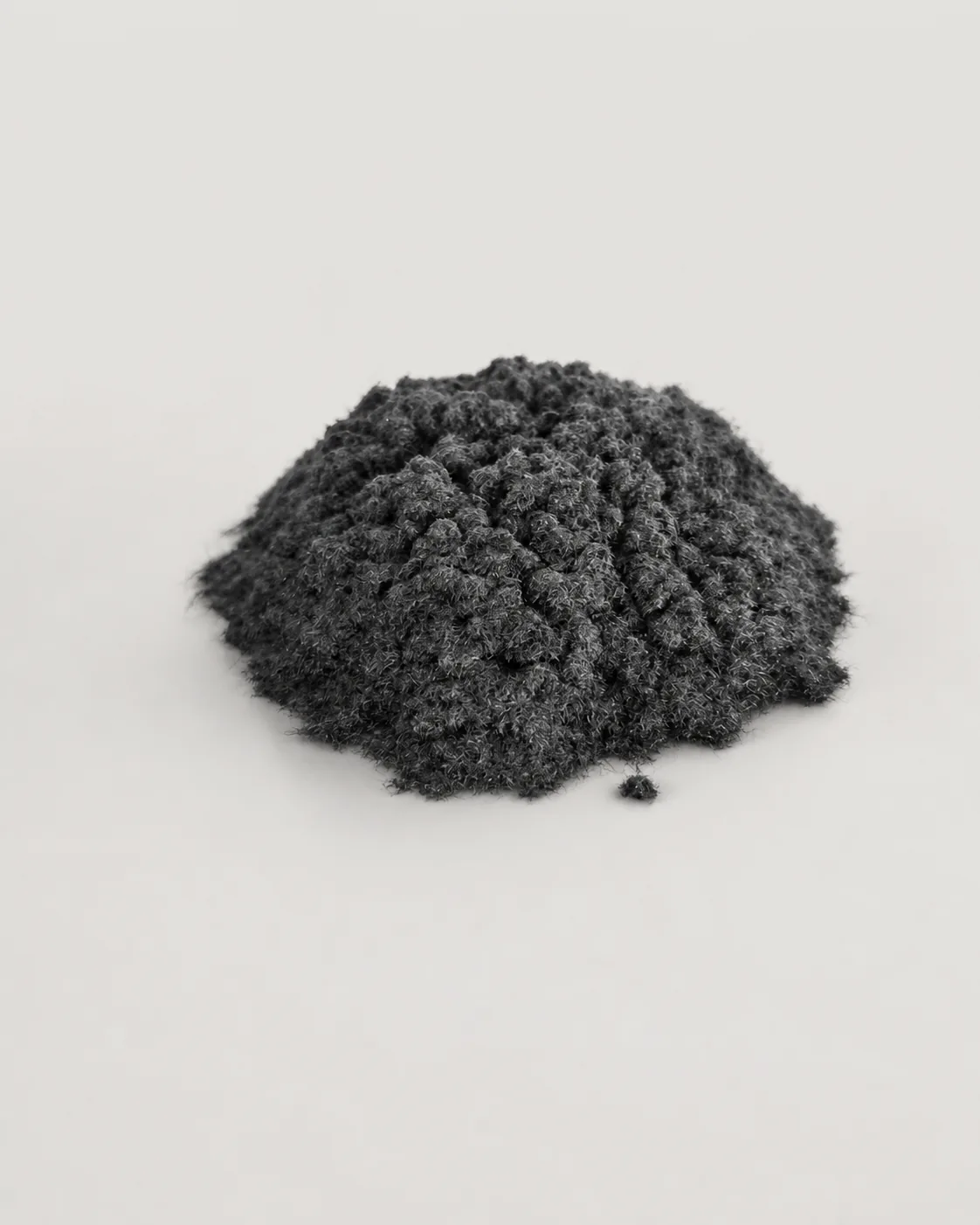
C Series Chopped Carbon Fiber
Mm-scale visible fiber, cut from continuous pitch-based carbon fiber tow. The 13.5 μm diameter delivers a stable reinforcement skeleton for visible-fiber dispersion in injection molding compounds, friction-material formulations, and needle-punched insulation felt precursors, supporting dimensional stability, compression resistance, and tribological compatibility.
C-12 · 12 mm (8–20 mm) · Friction material for brake pads
C-25 · 25 mm (20–30 mm) · Insulation-felt precursor
Graphitized versions are designated with the CG- prefix. Other lengths available on request.
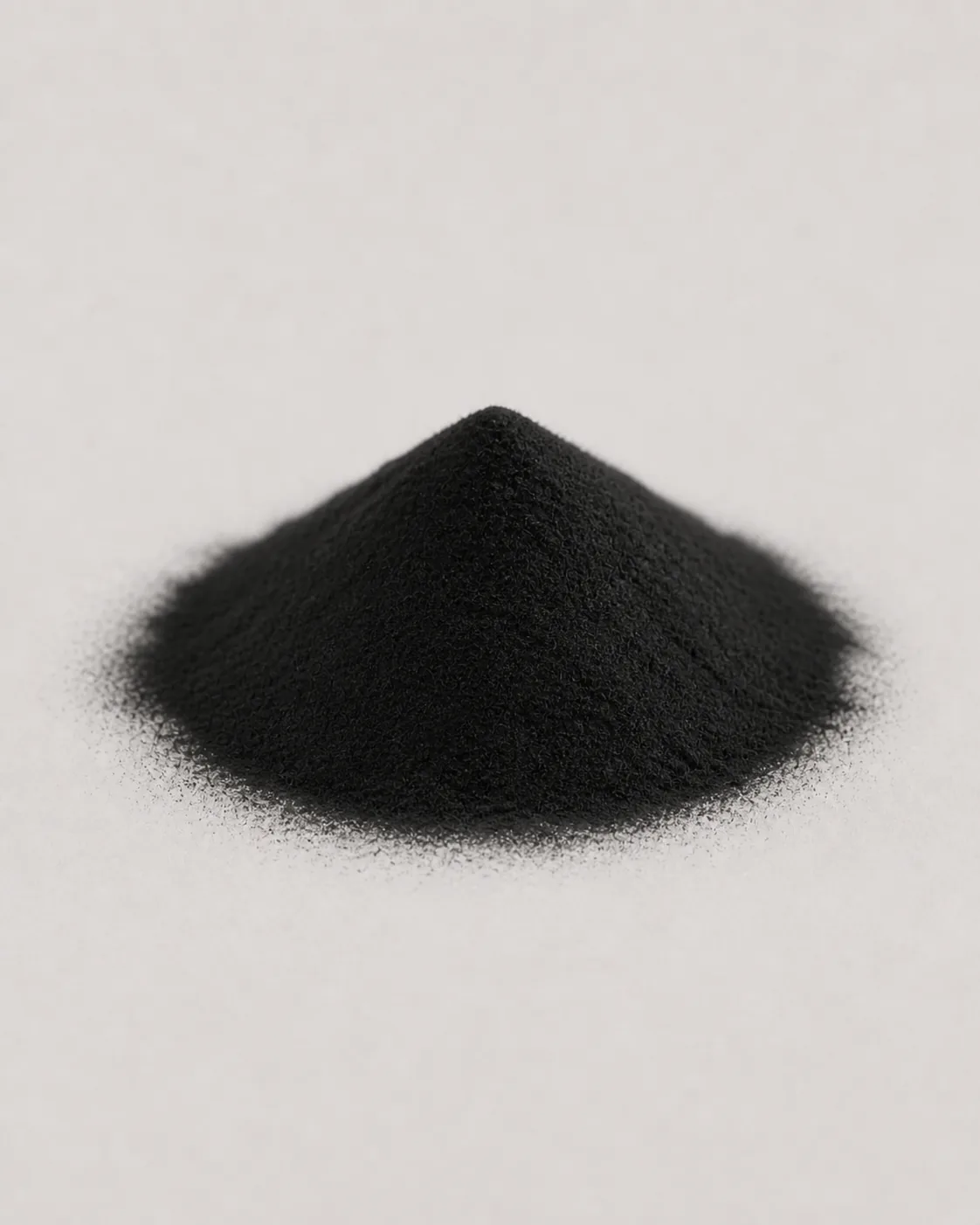
P Series Milled Carbon Powder
μm-scale powder, designed for precision composites that require uniform filling and controlled conductivity. Particle length spans 100 μm to 800 μm, covering coatings, PTFE gaskets, and ESD-grade engineering plastics such as IC trays. The graphitized grade (PG) ships at ash ≤ 200 ppm, supporting semiconductor-grade insulation and high-specification ESD applications.
P-200 · 200 μm · PTFE gaskets, rubber reinforcement
P-400 · 400 μm · IC tray ESD plastics
P-800 · 800 μm · Structural reinforcement filler
Graphitized versions are designated with the PG- prefix. Other particle sizes available on request.
Two grades. From industrial fillers to semiconductor-grade applications.
FiberElite products fall into one of two grades: standard (carbonized) or graphitized (CG / PG). Both grades share the same fiber geometry (13.5 μm diameter, tensile strength > 500 MPa) and differ on carbon content, ash, and resistivity. The table below shows core property comparison and the primary SKU list.
| Core Property | Unit | Standard GradeC / P · Carbonized | Graphitized GradeCG / PG |
|---|---|---|---|
| Carbon Content | % | > 99 | > 99.9 |
| Ash | ppm | ≤ 500 | ≤ 200 |
| Volume Resistivity | mΩ·cm | 3.0–6.0 | 1.0–3.0 |
| Fiber Diameter | μm | 13.5 (10–15) | 13.5 |
| Tensile Strength | MPa | > 500 | — |
| Tensile Modulus | GPa | > 40 | > 40 |
| Density | g/cm³ | > 1.55 | > 1.55 |
View full SKU list (C / CG / P / PG: 7 primary models × 2 grades) Expand
| Model | Form | LengthRange | Grade | Typical Application |
|---|---|---|---|---|
| C-6 / CG-6 | Chopped fiber | 6 mm (5–13) | Standard / Graphitized | Injection molding, conductive cement, general reinforcement |
| C-12 / CG-12 | Chopped fiber | 12 mm (8–20) | Standard / Graphitized | Brake pad friction materials |
| C-25 / CG-25 | Chopped fiber | 25 mm (20–30) | Standard / Graphitized | Insulation-felt precursor (needle-punched) |
| P-100 / PG-100 | Milled powder | 100 μm (80–150) | Standard / Graphitized | PTFE gaskets, coatings, conductive inks |
| P-200 / PG-200 | Milled powder | 200 μm (130–260) | Standard / Graphitized | PTFE gaskets, rubber reinforcement |
| P-400 / PG-400 | Milled powder | 400 μm (280–500) | Standard / Graphitized | IC tray ESD plastics |
| P-800 / PG-800 | Milled powder | 800 μm (700–950) | Standard / Graphitized | Structural reinforcement filler |
7 primary length specifications × standard / graphitized = 14 SKUs. Beyond the primary line, C series can be customized to 100–1200 mm long fiber and P series to 10–50 μm ultra-fine powder. Every batch is shipped with a certificate of analysis (carbon content, ash, resistivity, fiber-diameter distribution). MOQ starts at kg-level R&D samples; production orders supplied at metric-ton scale.
Sealing Gasket Reinforcement
Sealing gaskets demand a fiber phase optimized for compression resistance and long-term dimensional stability, not tensile strength. The 13.5 μm diameter of FiberElite is close to twice that of PAN-based fiber (around 7 μm), delivering a more robust load-bearing skeleton that resists collapse and migration under sustained compression and thermal cycling. Pitch-based carbon fiber also exhibits intrinsic lubricity and pairs well with PTFE and rubber matrices, qualifying it as a key reinforcement phase for high-performance automotive seals, valve gaskets, and pump-body sealing rings.
For soft PTFE gaskets, μm-scale milled powder is a suitable filler. Particle size is selected to disperse uniformly through the PTFE matrix without compromising the low-friction surface. Rubber seals operating under high load can use larger-particle powder for greater rigidity support. Semiconductor-grade sealing or purity-sensitive applications should specify the graphitized grade with ash ≤ 200 ppm. For asbestos-free flange gaskets, chopped fiber serves as a functional substitute for legacy asbestos formulations.
ESD Plastics, Coatings, and Semiconductor-Grade Fillers
Semiconductor wafers, electronic components, and flammable-storage environments are sensitive to static accumulation, but metal-like conductivity introduces short-circuit and electrical-safety risks. FiberElite, dispersed in PPO / PPE engineering plastics at typical loadings of 5–15% by weight, can bring surface resistance into the 10⁶ – 10⁹ Ω ESD-safe window: fast enough to dissipate static, slow enough to avoid forming a continuous conductive path. The same logic applies to cleanroom ESD floor coatings and conductive flooring tiles: at the same target conductivity, pitch-based carbon fiber can require lower loading than chopped straight fiber.
Compared to carbon black or graphite, carbon-fiber powder has limited effect on color formulation, supporting light-colored ESD plastic parts and tinted floor coatings. The 13.5 μm diameter also helps reduce the surface fiber-bloom commonly seen in thin-wall injection molding, leaving a cleaner molded surface for color-sensitive applications such as electronics housings and medical-device components.
Wafer fabrication is highly sensitive to metallic-ion contamination. The PG grade ships at ash ≤ 200 ppm and resistivity 1–3 mΩ·cm, making it suitable for IC trays, wafer carriers, and diffusion-furnace-related plastic components. For applications with tighter cleanliness requirements, the deep-purification version (ash < 20 ppm) is available on request.
Friction Materials and Sliding-Component Reinforcement
Brake-pad surface temperatures can spike above 600°C under heavy braking. Formulators need a fiber phase that is thermally stable (no decomposition or melting), chemically inert (no reaction with phenolic resin or metallic powders), and moderately conductive (heat dissipation without fade). Isotropic pitch-based carbon fiber meets all three. Mid-length chopped fiber is the mainstream choice for organic (NAO) and semi-metallic brake-pad formulations, with typical loadings at 2–8% by weight. The same logic carries over to clutch facings, where fiber length governs engagement smoothness.
Clutch facings need a stable friction coefficient and smooth engagement profile across repeated cycles. Fiber length sets the steepness of the engagement curve: mid-length chopped fiber suits passenger-vehicle applications, while longer fiber is engineered for commercial-vehicle and heavy-duty service. The chemical inertness and thermal stability of pitch-based fiber prevent burn-off and embrittlement under sustained high-frequency engagement, qualifying it as a compliant functional substitute for asbestos.
Pitch-based carbon fiber is intrinsically self-lubricating. Compounded into thermoset resins (phenolic, epoxy) or engineering plastics, milled powder can improve wear resistance and friction-coefficient stability of sliding pairs. Typical applications include pump-body liners, valve-stem seals, and bearing bushings for high-temperature service, cleanroom environments, or food-grade conditions where oil lubrication is not viable.
FiberElite chopped fiber is a regulation-compliant fiber phase for asbestos-free brake pads and friction materials. It supports export and domestic production without asbestos-regulation barriers. Typical loading in mainstream NAO formulations is 2–8% by weight.
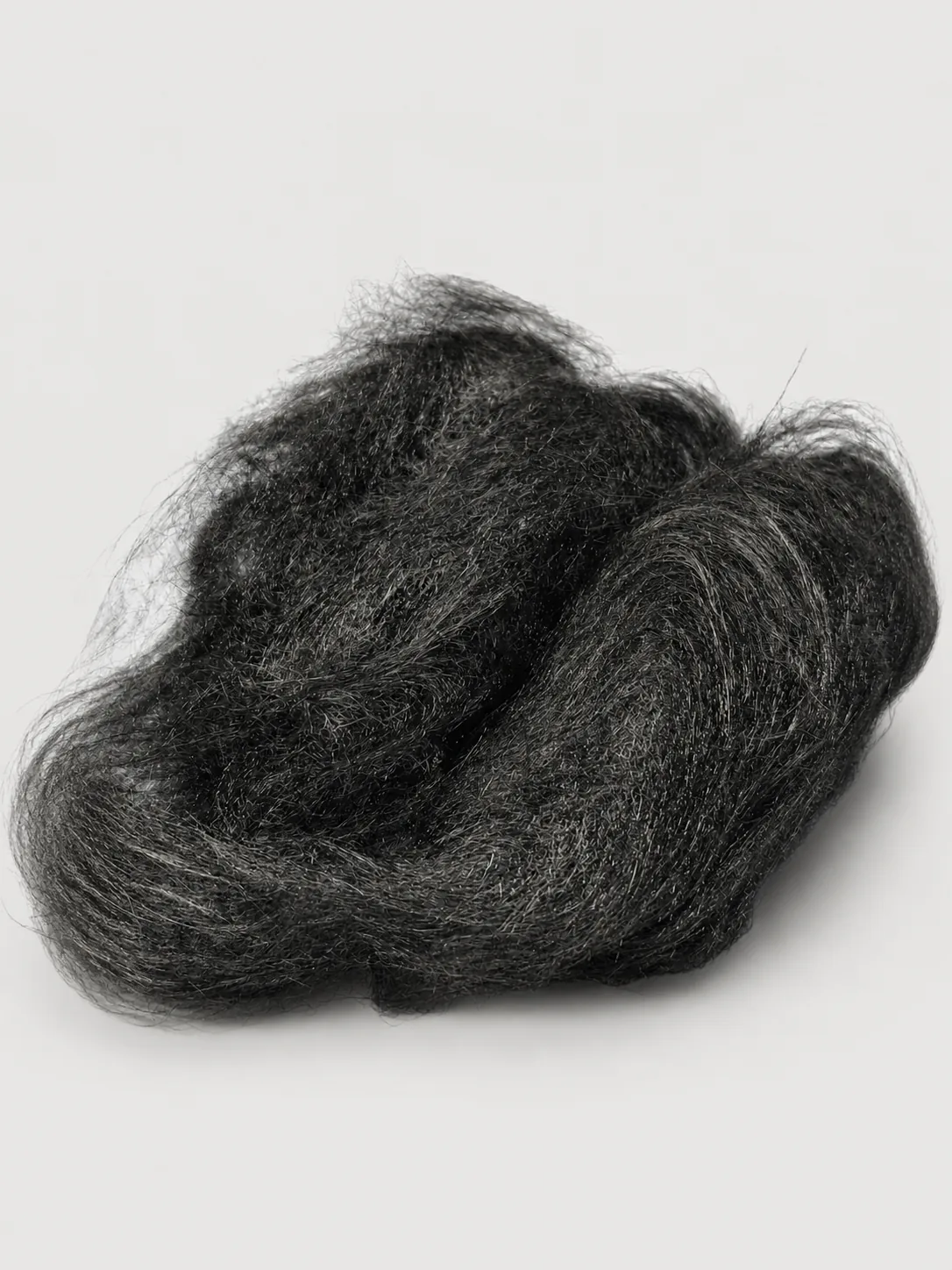
From fiber diameter to chemical purity.
Every parameter is engineerable.
-
01
Custom length and particle-size distribution
Beyond the seven primary specifications, the C series can be customized to 100–1200 mm long fiber (for needle-punched felt) and the P series to 10–50 μm fine powder (for specialty coatings and inks). Customers can specify mean, upper and lower bounds, and distribution shape.
-
02
Semiconductor-grade deep purification
On top of the standard graphitized grade (ash ≤ 200 ppm), an additional 2000–3000°C high-temperature purification step further reduces ash to < 20 ppm. Specified for crystal-growth hot zones, diffusion-furnace components, and other semiconductor environments sensitive to metallic-ion contamination.
-
03
Surface modification
For different matrices (PTFE, rubber, engineering plastics, resins), wettability and interfacial bonding can be tuned through oxidation treatment, sizing, and coupling-agent surface modification. The R&D team operates SEM, TGA, and surface contact-angle characterization in-house.
-
04
Rayon-based carbon fiber
Beyond the primary pitch-based line, AYD also supplies rayon-based carbon fiber for aerospace ablation, specialty low-conductivity applications, and similar use cases. Reach out for a technical evaluation.
Downloads
Standard SKU or custom specification?
Share your application, target length or particle size, purity requirement, and procurement scale. AYD can confirm a standard SKU or define a custom specification, from kg-level R&D samples to metric-ton production orders.