Pitch coating is a central surface engineering step across major anode routes. The amorphous carbon shell formed by carbonized pitch on graphite particles isolates the core from the electrolyte and guides a uniform, dense SEI, which determines initial coulombic efficiency, cycle life, and rate performance. Silicon-carbon anodes rely on pitch to buffer volume expansion; sodium-ion hard carbon elevates pitch from coating layer to main precursor.
AYD RefineU uses ethylene tar feedstock on a fully automated continuous line, with annual capacity of 25,000 tonnes and five standard softening-point grades from 145°C to 285°C. PE-150 is specified for liquid-phase coating on spheroidized natural graphite and silicon nanoparticles; PE-200, PE-250, and PE-280 support solid-phase coating at production scale. AYD also develops nitrogen-doped pitch, dual-step pre-oxidation routes, and mesophase pitch with anode material producers.
Four anode routes × Two process paths.
Different anode routes have different pitch requirements. Solid-phase coating suits large-scale production and needs medium-to-high softening point pitch. Liquid-phase coating supports nano-scale uniformity and requires low softening point pitch. The matrix below shows recommended RefineU grades across four key anode routes and two process paths.
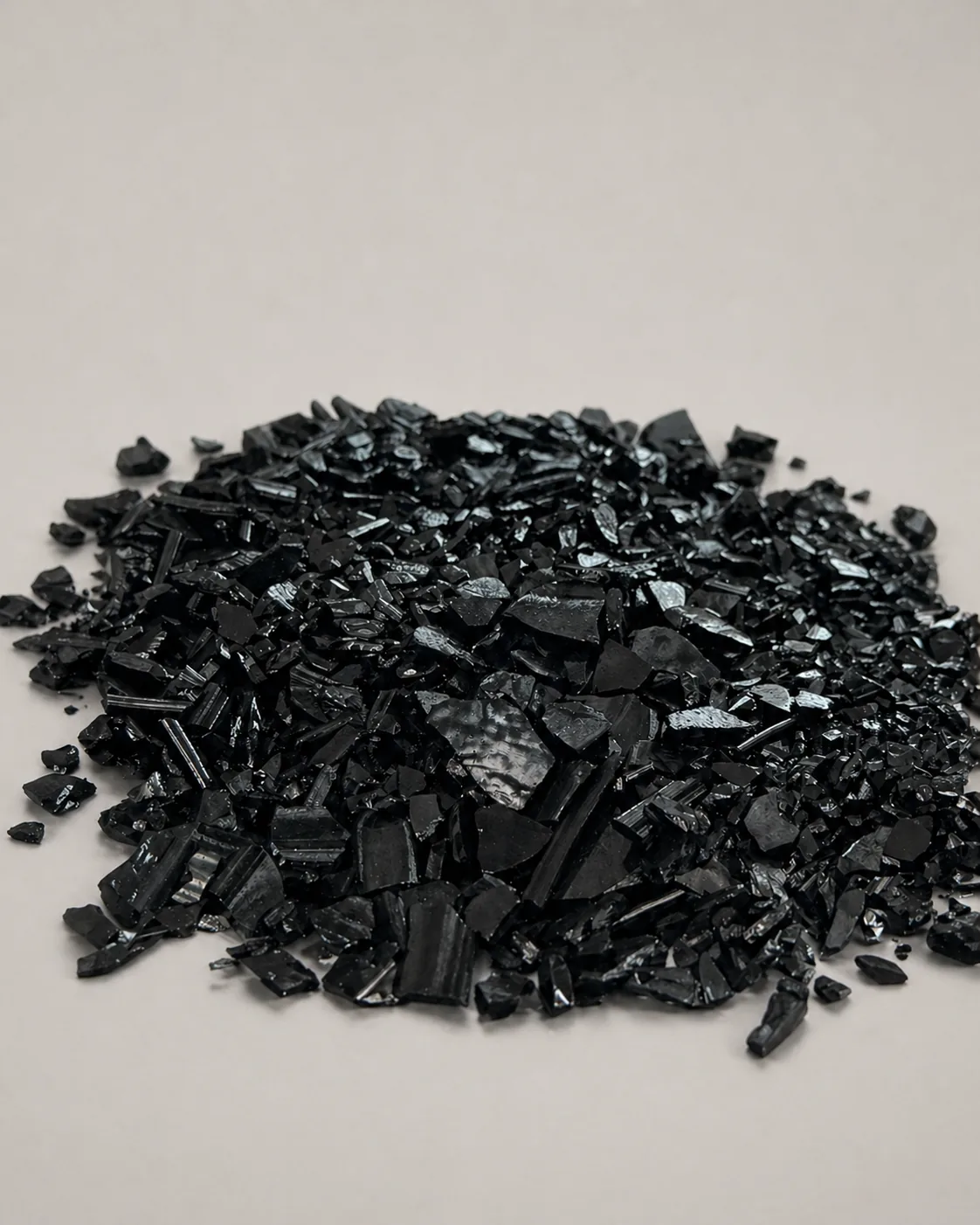
Carbon yield by grade: PE-200 ≥58%, PE-250 ≥67%, PE-280 ≥73%. Every batch ships with certificate of analysis.
Artificial Graphite Coating
Artificial graphite from petroleum or needle coke is graphitized at 2800–3000°C to deliver high gravimetric capacity and long cycle life. The bare surface, however, co-intercalates solvent in PC electrolytes, requiring a pitch-derived amorphous carbon shell to isolate it.
Solid-phase coating is the volume process: graphite and pitch powder dry-mixed at 90:10 to 95:5, melted above the softening point, then carbonized at 800–1100°C in nitrogen. The pitch must hold a softening point of 200–280°C to prevent agglomeration during mixing, deliver high carbon yield to maximize the hard carbon shell per unit pitch, and stay within tight QI limits to avoid hard particles.
RefineU PE-200 (carbon yield ≥58%) is the mainstream choice, balancing softening point and yield. PE-250 and PE-280 (≥67% and ≥73%) target higher initial coulombic efficiency and longer cycle life. Premium EV projects requiring even tighter coating uniformity can layer PE-150 liquid-phase coating as a secondary process on top.
Natural Graphite Coating
Spheroidized natural graphite delivers higher gravimetric capacity at lower cost than artificial graphite. Its surface, however, is heterogeneous, with pores, defects, and active edge sites that drive aggressive electrolyte side reactions, generate unstable SEI, and cause low first-cycle efficiency. Pitch coating is an essential surface engineering step for every commercial natural graphite anode.
Defect distribution on spheroidized graphite is highly heterogeneous; solid-phase coating can leave local gaps around pores and active edge sites. Liquid-phase coating is better suited to molecular-scale uniformity: pitch is dissolved in solvent (THF, toluene, or acetone), mixed with graphite, and then deposited as the solvent evaporates before carbonization. This route requires low softening point for rapid solvent dissolution, low QI to limit undissolved particles, and low ash to reduce metallic residues.
RefineU PE-150 (softening point 145–155°C) is the core feedstock for this route. QI ≤0.5% and ash ≤0.1% support the uniformity window required for spheroidized graphite coating. AYD's continuous line applies dedicated low-temperature thermal control and component management for low SP grades, addressing the batch-to-batch variability often seen in 150°C-class pitch products. R&D-stage customers can request kg-level samples and customized evaluations matching their solvent system.
Silicon-Carbon Composite Anode
Silicon offers a theoretical capacity of 4200 mAh/g, roughly 11× that of graphite (372 mAh/g), making it a major route to higher energy density. But silicon undergoes up to 300% volume expansion during lithiation, causing particle pulverization, electrode failure, and continuous SEI consumption. The common commercial approach combines nano-silicon with graphite or hard carbon, wrapped in a flexible pitch-derived carbon shell.
The pitch shell in silicon-carbon composites serves two functions: mechanical buffering, where the carbon shell offers appropriate flexibility and strength to absorb silicon's volume expansion and reduce pulverization; and electronic pathway, where the amorphous carbon layer provides much higher conductivity than bulk silicon, supporting lithium-ion and electron transport to embedded particles.
Silicon-carbon composites typically use a two-step pitch coating. The solid-phase step uses RefineU PE-280 (carbon yield ≥73%) to build the high-yield primary carbon shell. The liquid-phase step uses PE-150 for nano-scale fine coating of nano-silicon particles. AYD evaluates pitch formulations for silicon buffer layers across silicon sources including nano-Si, SiOx, and Si@C core-shell systems.
Sodium-ion Hard Carbon Anode
Sodium-ion batteries target low-cost storage and entry-level EVs, with abundant sodium resources at far lower cost than lithium. Graphite cannot accommodate the larger sodium ion in stable intercalation. The commercial route uses hard carbon, a disordered, porous, non-graphitizable carbon that stores sodium in interlayer spaces, nano-pores, and defect sites.
In sodium hard carbon, pitch is elevated from a coating layer to the main precursor. Low softening point pitch, after pre-oxidation crosslinking and high-temperature carbonization, forms hard carbon with large interlayer spacing and abundant nano-porosity. Pitch carbon yield (47–73%) is higher than many biomass routes, giving pitch-based hard carbon potential advantages in yield and scalability.
RefineU PE-150, with its low softening point and good pre-oxidation reactivity, is used as a research feedstock for sodium hard carbon precursors. AYD studies nitrogen-doped pitch modification: introducing nitrogen-bearing species during the melt stage allows the final hard carbon to retain nitrogen atoms within its sp² network, supporting reversible sodium storage. Scaled production routes can be evaluated with universities and sodium-ion anode material companies.
RefineU Petroleum Pitch Series
Five standard softening point grades (PE-150 / PE-180 / PE-200 / PE-250 / PE-280) covering both solid-phase and liquid-phase coating. Ethylene tar feedstock, fully automated continuous production line, 25,000 t/year capacity. QI ≤0.5%, ash ≤0.1%. Every batch shipped with certificate of analysis.
View Product SpecsCustom Modified Pitch
N-doped pitch, custom softening points with ±5°C precision, mesophase pitch research, and low-QI ultra-low-ash specialty processing. TGA, FT-IR, and GPC characterization support development work for sodium hard carbon, silicon buffer layers, and related next-generation anode systems.
Learn About R&DChoose the right pitch grade for your anode route.
Share your anode system, target performance metrics, coating route, and order volume. AYD can recommend the softening-point grade, process path, and modification direction, from kg-level R&D samples to tonne-level orders.